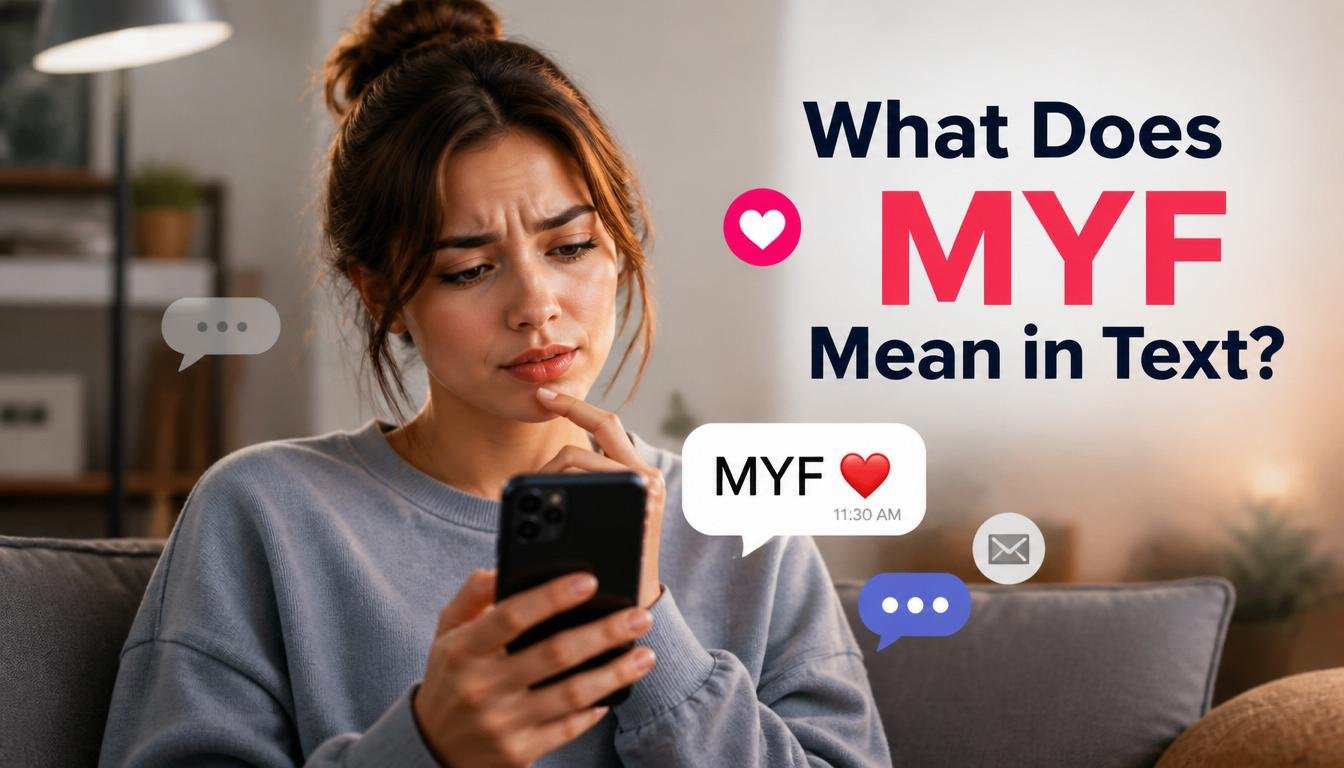
If someone texted you “MYF” and you’re wondering what they meant, the most likely answer is “Miss Your Face.” It’s an informal, affectionate phrase people may use with friends, family members, or romantic partners when they haven’t seen each other for a while.
But here’s the catch: MYF isn’t a universally standardized texting abbreviation. Depending on the conversation, sender, and online community, it can have other meanings too.
That’s why the smartest way to understand MYF meaning in text isn’t to memorize one definition. You need to look at the context around it. This guide explains the likely meanings, shows how the abbreviation works in real conversations, and gives you a simple way to figure out what someone actually meant.
What Does MYF Mean in Text?
MYF most commonly means “Miss Your Face” in casual, personal texting. It’s a playful way of saying that you miss someone and haven’t seen them recently.
For example:
“It’s been forever since we hung out. MYF!”
Here, the meaning is pretty clear. The sender is expressing affection and saying they miss seeing you.
You may also see it with emojis:
“MYF “
“MYF already! “
The tone is usually warm and personal. It can be friendly or romantic depending on who sent the message.
What is the most likely meaning of MYF?
In an affectionate conversation, “Miss Your Face” is the strongest interpretation. If someone has just moved away, gone on vacation, or hasn’t seen you for a while, MYF probably carries that meaning.
Still, I wouldn’t treat it as a hard rule. MYF is not as universally understood as abbreviations such as LOL or BRB, so context matters.
Does MYF have one official meaning?
No. MYF does not have one official meaning that applies to every text message.
Acronym reference sites record multiple meanings for MYF across different contexts. That doesn’t mean all of those meanings are equally popular in everyday texting. It simply shows that the abbreviation can represent different phrases depending on where and how it is used.
This distinction is easy to miss. A definition appearing on an acronym website doesn’t automatically prove that it is a common meaning among everyday texters.
Why can the meaning change between conversations?
Text slang is highly dependent on context. People also create their own shorthand within friend groups, online communities, and private conversations.
For example:
“MYF “
is likely affectionate.
But:
“MYF, I forgot to send the file.”
doesn’t naturally suggest “Miss Your Face.” The second example needs more context before you can confidently interpret the abbreviation.
The practical rule: Don’t decode MYF by looking at the three letters alone. Read the conversation around them.
What Are the Different Meanings of MYF?
MYF can have several possible meanings, although “Miss Your Face” is one of the clearest interpretations in affectionate personal texting. Other interpretations may appear in specific conversations, so it’s better to think of MYF as a context-dependent abbreviation.
| MYF Meaning | Likely Context | Tone | Example |
| Miss Your Face | Friends, family, romantic conversations | Affectionate | “Haven’t seen you in ages. MYF!” |
| My Friend | Informal personal conversations | Casual | “I’ll ask MYF about it.” |
| My Fault | Apologies or admitting responsibility | Casual | “MYF, I misunderstood you.” |
| Other meanings | Specialized communities or subjects | Varies | Depends on context |
Reference sources such as Abbreviations.com list multiple meanings for MYF across different categories. That supports the broader point that MYF isn’t restricted to a single definition. However, those listings shouldn’t be treated as proof that every listed meaning is equally common in modern texting.
MYF as “Miss Your Face”
“Miss Your Face” is the most natural interpretation when MYF appears in an affectionate conversation.
You might see:
“Come visit soon. MYF!”
Or:
“Had so much fun last weekend. MYF already.”
The phrase has a playful quality that “I miss you” doesn’t always have. It’s especially natural between people who already have a close relationship.
MYF as “My Friend”
In some contexts, MYF may be interpreted as “My Friend.”
For example:
“I’ll check with MYF and get back to you.”
Here, someone might be using MYF as shorthand for “my friend.” However, this isn’t necessarily a standard interpretation that every reader will recognize.
That’s why you shouldn’t assume this meaning without context.
MYF as “My Fault”
MYF may also be interpreted as “My Fault” in a conversation where someone is admitting responsibility.
For example:
“Sorry, I sent you the wrong link. MYF.”
The context makes the intended meaning easier to understand.
However, if someone simply sends “MYF” by itself, “My Fault” isn’t automatically obvious. A reader may interpret it differently.
Can MYF have a rude or offensive meaning?
Some sources may associate MYF with less common or potentially offensive interpretations, but you should not assume a rude meaning without clear contextual evidence.
Internet slang is full of abbreviations that vary between communities. An interpretation used by one niche group may be completely unfamiliar to everyone else.
This is one reason I would avoid articles that confidently declare one obscure expansion to be the meaning of MYF without showing evidence.
What does MYF mean outside texting?
Outside texting, MYF may refer to unrelated acronyms, organizations, terms, or names.
This is why searching for “MYF meaning” can produce different results from searching specifically for “MYF meaning in text.”
The context of the search matters. Someone looking for texting slang wants a different answer from someone researching an organization or technical abbreviation.
How Do You Know Which MYF Meaning Someone Intended?
The best way to interpret MYF is to examine the surrounding conversation, your relationship with the sender, and the tone of the message.
I call this the MYF Context Decoder:
1. Read the complete message.
Don’t interpret MYF in isolation.
2. Consider who sent it.
A close friend may use slang differently from a coworker.
3. Check the conversation topic.
Were you discussing missing someone, an apology, or something completely different?
4. Look at the tone.
Is the message affectionate, funny, serious, or irritated?
What words appear around MYF?
Words such as miss, visit, see you, away, gone, catch up, soon, love, and remember may support an affectionate interpretation.
For example:
“Wish you were here. MYF!”
The surrounding words strongly suggest that the sender means “Miss Your Face.”
But these clues aren’t absolute rules. They’re simply evidence that helps you narrow down the meaning.
Who sent the message?
The sender’s relationship with you can completely change the interpretation.
If your partner writes:
“MYF “
you’ll probably understand the emotional meaning immediately.
If a coworker writes:
“MYF, sorry about that.”
you may need clarification.
The important point is that abbreviations don’t exist separately from human relationships. The person sending the message is part of the context.
What was the conversation about?
This may be the most useful clue of all.
If you’ve been discussing an upcoming reunion, “Miss Your Face” makes sense.
If you’ve been talking about a mistake, another interpretation might fit better.
If you’re discussing a particular organization or online community, MYF could have a completely unrelated meaning.
Was the tone friendly, emotional, or annoyed?
Even punctuation can change the feel of a message.
Compare:
“MYF “
with:
“MYF.”
They contain the same letters, but they don’t necessarily communicate the same emotion.
Emojis, punctuation, and surrounding words all contribute to the meaning.
Was MYF written alone or inside a sentence?
This is an underrated clue.
When someone sends:
“MYF “
The context is limited, but the emotional signal is strong.
When MYF appears inside a longer sentence, you have more information to work with.
Expert tip: If you’re confused, read the previous two or three messages before MYF. In informal communication, the conversation history often explains the abbreviation better than any dictionary.
MYF Meaning in Text Examples
The easiest way to understand MYF is to see how the meaning changes with context.
MYF between close friends
Alex: “You better come back soon. It’s boring without you.”
Sam: “Haha, MYF too!”
Here, “Miss Your Face” is the natural interpretation. The conversation is clearly about missing someone who is away.
MYF in a romantic conversation
Partner: “Wish you were here tonight.”
You: “MYF “
In this context, MYF can express affection and longing. It may feel more playful than simply writing “I miss you.”
MYF in a social media DM
“Saw your vacation pictures! MYF “
This could mean “Miss Your Face,” especially if the sender knows you personally.
However, social media brings together people from different regions and communities. If the abbreviation doesn’t fit the conversation, don’t force the interpretation.
MYF in a tense conversation
Person A: “Why didn’t you tell me about the change?”
Person B: “MYF. I thought you already knew.”
Here, the intended meaning isn’t obvious. You need more context before deciding what MYF stands for.
MYF in a group chat
Group chats are particularly tricky because people often develop their own shorthand.
One person might use MYF to mean something completely different from what another person expects.
Original insight: Private group slang is one reason online abbreviation databases can never fully capture how people actually communicate. People constantly invent shortcuts that make sense within a particular social circle.

How Should You Reply When Someone Texts MYF?
If MYF clearly means “Miss Your Face,” you can respond with something warm such as “Miss you too!” or “MYF too!” If the meaning isn’t obvious, ask the sender instead of guessing.
How do you reply if MYF means “Miss Your Face”?
You could say:
“Miss you too! “
Or:
“Aww, MYF too! We need to meet soon.”
For a casual response:
“Same here Let’s catch up soon!”
Your reply doesn’t have to repeat the abbreviation. Respond naturally to the emotion behind it.
What if you’re unsure what MYF means?
Try:
“Wait, what do you mean by MYF?”
Or:
“MYF means what here? “
That’s completely reasonable, especially if you’re talking to someone you don’t know well.
How can you ask for clarification naturally?
Keep it simple.
“What does MYF mean here?”
is much more natural than asking for a formal explanation of the acronym.
Expert tip: Clarifying an abbreviation isn’t awkward. Pretending you understand when you don’t can create a much bigger misunderstanding.
Is MYF Appropriate for Professional Messages?
MYF is generally better suited to casual personal conversations than professional communication.
In a work email, for example, writing:
“MYF about the missed deadline.”
could confuse the recipient.
A clearer version would be:
“My fault about the missed deadline.”
or:
“I apologize for missing the deadline.”
Can you use MYF at work?
You can use it in an informal workplace chat if your team already understands the abbreviation.
But for important messages, clarity should come first.
Should brands use MYF on social media?
Brands should be careful with slang.
A company targeting a young audience may use informal language successfully, but only if the audience understands it naturally. Using slang simply to appear trendy can make a brand sound forced.
When is casual slang appropriate?
MYF is more suitable when:
- The conversation is informal.
- The recipient understands the abbreviation.
- The relationship is already familiar.
- A misunderstanding won’t cause a serious problem.
Avoid it in formal emails, client communication, legal matters, financial discussions, and other situations where precision matters.
MYF vs. Similar Texting Abbreviations
MYF is more context-dependent than many common texting abbreviations. While expressions such as IMY and BFF are widely recognized, MYF may require more interpretation.
| Abbreviation | Common Meaning | Typical Use | Clarity |
| MYF | Miss Your Face | Affectionate personal texts | Context-dependent |
| IMY | I Miss You | Personal or romantic texts | Relatively clear |
| BFF | Best Friends Forever | Friendship | Widely recognized |
| MYB | Multiple possible meanings | Context-dependent | Ambiguous |
MYF vs. IMY
IMY usually means “I Miss You.”
It’s more direct than MYF.
“IMY “
and
“MYF “
can communicate similar emotions, but MYF often has a more playful and personal feel.
MYF vs. MYB
MYB can have different meanings depending on context, making it another example of why abbreviations shouldn’t always be interpreted in isolation.
If you see MYB or MYF and aren’t sure what the sender means, look at the complete sentence.
MYF vs. BFF
BFF means “Best Friends Forever” and is widely recognized.
MYF, by contrast, expresses a feeling of missing someone.
You might say:
“She’s my BFF. MYF!”
The first describes the relationship. The second expresses an emotional reaction to being apart.
Expert Tips for Understanding MYF
The best MYF interpretation comes from context, not from blindly choosing the first definition you find online.
1. Use the substitution test
Replace MYF with a possible meaning and read the sentence again.
“Haven’t seen you in months. Miss Your Face!”
That works naturally.
Now:
“Miss Your Face, I forgot to attach the document.”
That doesn’t make sense.
This quick test can help eliminate interpretations that don’t fit.
2. Check the previous messages
Don’t just read the sentence containing MYF. Look at what happened immediately before it.
The conversation often provides the missing information.
3. Consider the sender’s normal communication style
If someone never uses abbreviations, their use of MYF may be intentional or personal.
If they constantly use slang, MYF may simply be part of their normal texting style.
4. Don’t confuse a listed definition with a popular definition
This is one of the biggest traps in researching internet slang.
A term appearing in an acronym database doesn’t prove that it is widely used today. Without a reliable, representative dataset of current text messages, precise usage percentages should not be claimed.
5. Don’t overthink an obvious message
If your best friend sends:
“MYF “
After you’ve been apart for months, you probably don’t need to investigate every possible acronym expansion.
Context has already done most of the work.
Common Mistakes People Make When Interpreting MYF
Assuming MYF always means “Miss Your Face”
It’s a likely interpretation in affectionate conversations, but not a universal rule.
Better approach: Check the conversation before deciding.
Treating every online definition as equally common
Some definitions may be niche, outdated, or rarely used.
Better approach: Separate a possible meaning from a likely meaning.
Ignoring the sender’s relationship with you
A romantic partner and a coworker may use the same abbreviation differently.
Better approach: Consider who is speaking and how well you know them.
Using MYF professionally without considering the audience
You may understand the abbreviation perfectly while the recipient doesn’t.
Better approach: Use clear language when the stakes are high.
Assuming the first search result is automatically correct
Search results can repeat the same information across multiple websites. Repetition isn’t independent evidence.
Better approach: Compare sources and then apply the meaning to the actual conversation.
Overexplaining an obvious message
If the context clearly shows that MYF means “Miss Your Face,” there’s no need to search for obscure interpretations.
Better approach: Use common sense first, then investigate further only when the context is genuinely unclear.
FAQs
What does MYF mean in text?
MYF most commonly means “Miss Your Face” in casual personal texting. It is usually an affectionate way to say that you miss seeing someone, although the exact meaning depends on context.
What does MYF stand for in texting?
In texting, MYF can stand for “Miss Your Face.” However, MYF is not a universally standardized abbreviation, so other meanings may appear in different conversations or online communities.
Does MYF always mean “Miss Your Face”?
No, MYF does not always mean “Miss Your Face.” The surrounding conversation, relationship between the sender and recipient, and tone can help determine what the sender intended.
What does MYF mean on Snapchat or Instagram?
On Snapchat or Instagram, MYF can mean “Miss Your Face” when used in a personal or affectionate conversation. Because social media slang varies between communities, check the context if the meaning isn’t obvious.
How do you respond to MYF in a text?
If MYF means “Miss Your Face,” you can respond with “Miss you too!” or “MYF too!” If you’re unsure what it means, simply ask the sender, “What does MYF mean here?”
Is MYF a common texting abbreviation?
MYF is used in informal digital communication, but it is less universally recognized than abbreviations such as LOL, BRB, or BFF. Not everyone will immediately understand it, so context is important.
What does MYF mean from a girl or guy?
If someone texts you MYF in a warm, personal conversation, it may mean “Miss Your Face,” regardless of the sender’s gender. The relationship and context are more useful clues than whether the sender is a girl or guy.
Is MYF appropriate to use in professional texts?
MYF is generally better suited to casual conversations than professional communication. Because it can be ambiguous, it’s safer to use the full phrase or clearer wording with clients, managers, coworkers, and business contacts.
Conclusion
The three things to remember about MYF meaning in text are simple:
- MYF often means “Miss Your Face” in casual and affectionate conversations.
- MYF doesn’t have one universal definition, so other interpretations are possible.
- Context is your best clue—look at the surrounding messages, the sender’s relationship with you, and the tone.
Your next step is straightforward: read the complete conversation before deciding what MYF means. If “Miss Your Face” fits naturally, that’s probably the intended meaning. If it doesn’t, ask the sender rather than guessing.
When it comes to texting slang, the letters are only half the story. The conversation around them is what usually reveals the real meaning.
Leave a Reply